

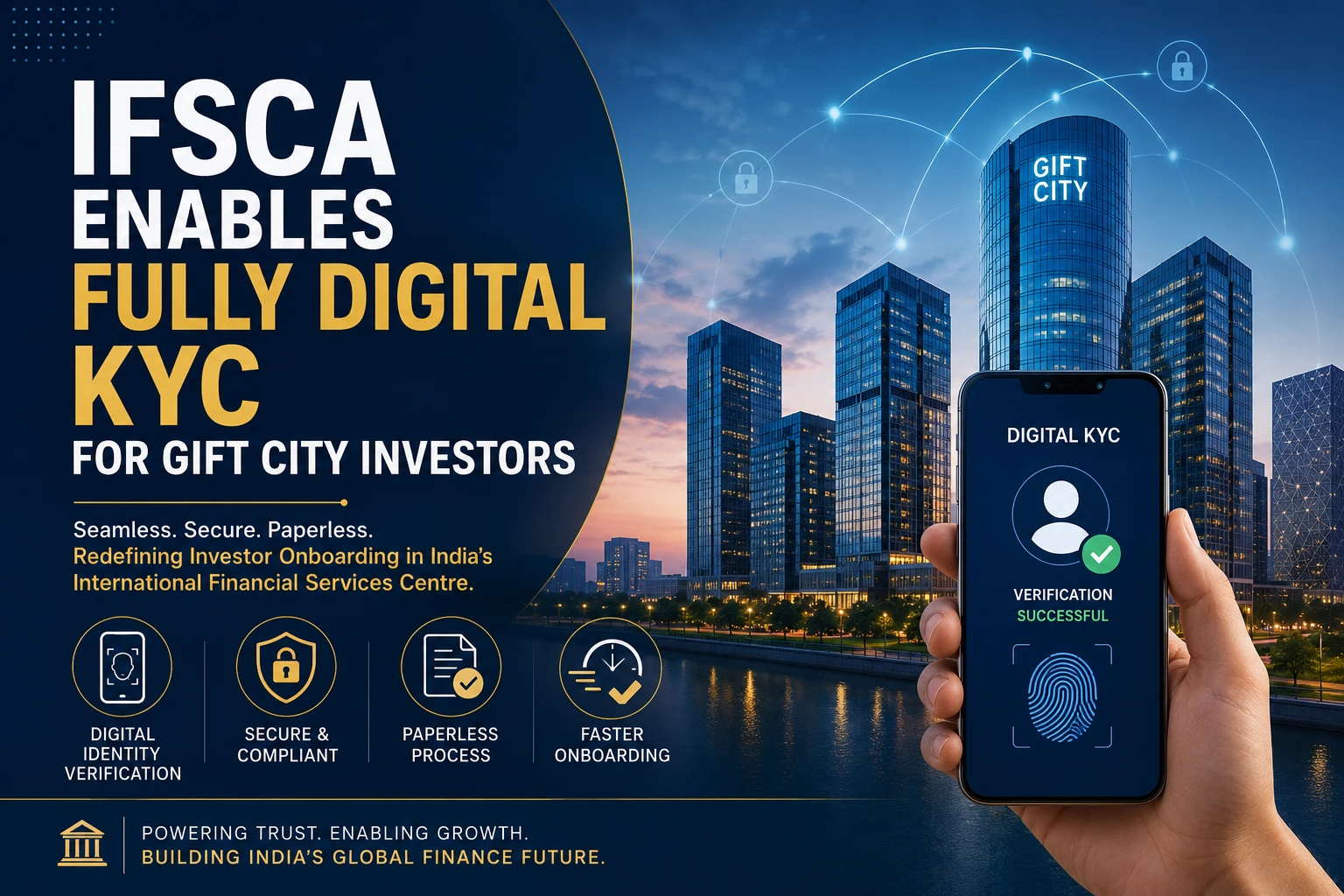
The International Financial Services Centres Authority has made overseas investor onboarding easier by allowing regulated financial institutions in GIFT City to complete Know Your Customer processes digitally.
The change is expected to reduce the paperwork, physical verification and document-delivery challenges that overseas investors and Non-Resident Indians previously faced while opening accounts or accessing financial services through India’s International Financial Services Centre.
By recognising digitally authenticated documents, IFSCA has taken another step towards making GIFT City more accessible to global investors while maintaining regulatory and compliance standards.
What Has Changed in the KYC Process?
Under the updated framework, banks, brokers, fund managers and other regulated entities operating in GIFT City can accept certain overseas documents in digital form.
The recognised authentication methods include electronically notarised documents, electronic apostilles and verifiable electronic signatures, provided they are legally valid in the country or jurisdiction where the documents were issued or executed.
This means an overseas investor may no longer need to print documents, visit a notary or embassy and send physical copies to India through an international courier in every case.
The updated process allows identity and supporting documents to move through secure digital channels, making onboarding more convenient and efficient.
How the Earlier Process Created Difficulties
Before digital document authentication was recognised more clearly, overseas investors often had to complete several offline formalities.
Documents such as address proofs, declarations, identity records and powers of attorney could require physical notarisation, certification, apostille verification or embassy authentication. Once verified, the documents frequently had to be couriered to the financial institution in India.
For investors living outside the country, this process could take considerable time and involve multiple service providers. Delays in notarisation, embassy appointments and international delivery could slow account activation and discourage investors from completing the application.
The digital approach aims to remove these operational barriers without changing the fundamental purpose of KYC verification.
Benefits for Overseas Investors and NRIs
The most immediate benefit is faster onboarding.
Investors can submit digitally authenticated documents without depending entirely on physical delivery. This may shorten the time required to open investment, banking or brokerage accounts in GIFT City.
The change can also reduce courier expenses, repeated document submissions and the inconvenience of visiting physical authentication centres.
For NRIs and foreign investors seeking access to funds, capital-market products, banking facilities and other financial services available in GIFT IFSC, the updated process can provide a smoother entry point.
However, the actual onboarding experience will depend on how quickly individual institutions update their systems and internal procedures.
Why the Development Matters for GIFT City
GIFT City is being developed as India’s international financial hub and competes with established centres such as Dubai, Singapore and Hong Kong.
Global investors generally expect account opening and financial services to be available through secure digital platforms. Lengthy paper-based procedures can make a financial centre less attractive, particularly when competing jurisdictions provide faster digital onboarding.
By supporting paperless KYC and digital document authentication, IFSCA is helping GIFT City align more closely with international financial-service practices.
The development may also support increased participation in GIFT City’s banking, investment-fund, securities and brokerage ecosystem by making services more accessible to investors living abroad.
Compliance Requirements Remain in Place
The introduction of digital KYC does not remove compliance obligations or lower verification standards.
Regulated institutions must continue to follow Anti-Money Laundering, Combating the Financing of Terrorism and customer due-diligence requirements.
Banks, brokers and fund managers remain responsible for confirming the authenticity and legal validity of documents submitted digitally. They must also perform the required risk checks before approving an investor’s account.
The main change is therefore in the method of verification. Physical document authentication is being replaced or supplemented by legally recognised digital authentication, while the underlying compliance responsibilities remain unchanged.
Implementation by Financial Institutions Will Be Important
Although IFSCA has provided regulatory clarity, every financial institution operating in GIFT City will need to integrate the permitted digital methods into its onboarding systems.
Banks, brokers and fund managers may need to update their technology, document-verification workflows and compliance procedures before offering a completely digital experience.
Investors should therefore check the onboarding requirements of their selected institution, as implementation timelines and accepted document formats may vary.
Conclusion
IFSCA’s decision to support fully digital KYC is an important development for overseas investors seeking financial opportunities in GIFT City.
By accepting digitally authenticated documents, the framework can reduce paperwork, international courier requirements and onboarding delays. At the same time, regulated institutions must continue to maintain strict verification, AML and customer due-diligence standards.
The move strengthens GIFT City’s digital infrastructure and supports its ambition to become a competitive and globally connected international financial centre.
