

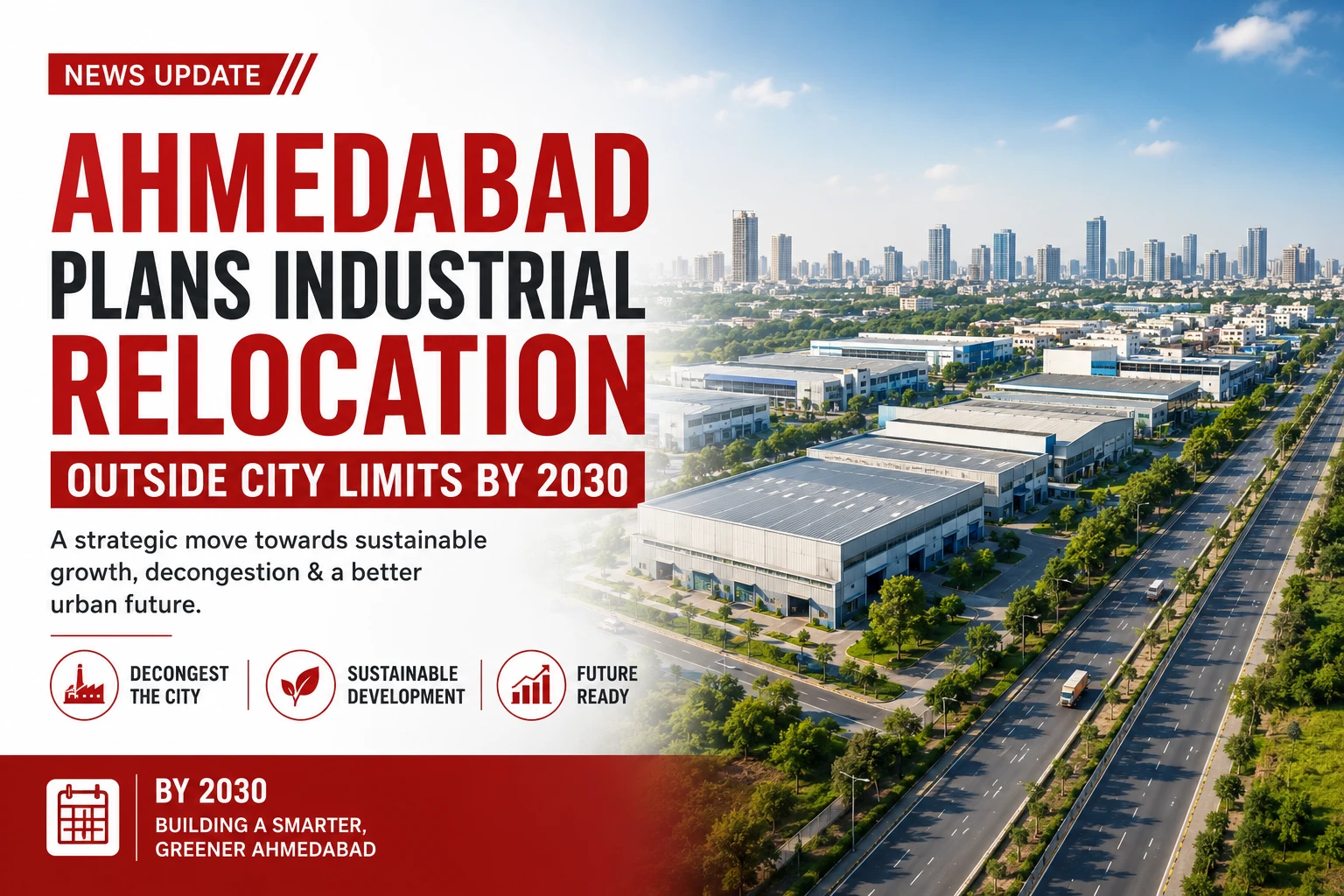
Ahmedabad could undergo a major transformation in its industrial landscape over the next few years as authorities consider moving industrial activities away from the city's urban limits.
The proposed change forms part of Ahmedabad's longer-term urban development strategy as the city prepares to host the 2030 Commonwealth Games and strengthens infrastructure linked to India's ambitions for the 2036 Olympic Games. Ahmedabad was formally confirmed as the host of the 2030 Commonwealth Games in November 2025, while India's effort to host the 2036 Olympics is still at the bid stage.
Industrial Zones Within Ahmedabad Could Be Reclassified
According to the reported development proposal, industrial zones currently located within the jurisdiction of the Ahmedabad Municipal Corporation (AMC) and the Ahmedabad Urban Development Authority (AUDA) could eventually be converted to non-industrial land-use zones.
The plan would also restrict the establishment of new industrial units within these urban limits.
Existing industrial businesses may face limitations on major expansion or restructuring at their present locations as authorities work towards gradually reducing industrial activity inside densely developed parts of Ahmedabad. However, several implementation details are still under consideration and should not yet be treated as final regulations.
Relocation Target Reported for 2030
Under the proposal reported by government sources, existing industries could receive a transition period before being expected to move to designated industrial locations outside the city's urban boundaries.
The broader objective is reportedly to complete the industrial relocation process by around 2030.
The move is expected to be implemented through a structured transition rather than an immediate shutdown of existing industrial facilities. Authorities are considering mechanisms that would enable businesses to shift operations while Ahmedabad gradually redesigns its urban land-use pattern.
Project THRIVE to Support Industrial Relocation
The relocation initiative is closely connected with Project T.H.R.I.V.E. — Transition for Harmonized Relocation and Inclusive Vibrant Economy, introduced under the Gujarat Industrial Policy 2026.
The Gujarat government's official announcement of the new industrial policy identifies Project THRIVE as an initiative aimed at encouraging the relocation of industries away from congested urban areas.
Rather than relying only on restrictions, the policy framework is designed to make relocation financially and operationally more attractive for eligible industrial units.
GIDC Industrial Estates Could Also Come Under the Plan
The proposed transition is not expected to be limited only to individually operated factories.
According to the reported plan, industrial estates associated with the Gujarat Industrial Development Corporation (GIDC) within the affected urban areas may also form part of the relocation framework.
If implemented as proposed, AMC, AUDA and relevant state departments would need to coordinate a time-bound transition of affected industries towards designated industrial areas outside the city's limits.
Higher FSI Could Encourage Industries to Relocate
One of the important incentives being considered involves Floor Space Index (FSI).
Industries shifting operations under the THRIVE framework could potentially receive substantially higher FSI at their new locations. Government sources cited in the report indicated that at least double the existing level could be considered for qualifying relocation projects.
The government has also been considering relief related to land-use conversion charges. These measures are intended to reduce some of the financial burden associated with shifting an established industrial operation to a new site.
Pollution Reduction Is a Major Objective
A major reason behind the proposed industrial restructuring is Ahmedabad's urban environment.
Moving polluting industrial activities away from densely populated areas could help authorities address air pollution, industrial emissions, land-use conflicts and other environmental pressures created as residential and commercial development expands around older industrial clusters.
The proposal therefore represents more than simply relocating factories. It reflects a broader attempt to reorganise Ahmedabad's urban development pattern while preparing the city for major international sporting events and future population and infrastructure growth.
What Could the Plan Mean for Ahmedabad's Industrial Sector?
If the proposal is formally implemented, manufacturers operating within AMC and AUDA limits may need to start assessing their long-term location strategies.
Industrial businesses would potentially need to evaluate suitable relocation destinations, infrastructure availability, workforce accessibility, transportation connectivity, land requirements and eligibility for benefits available through Project THRIVE.
At the same time, areas outside Ahmedabad's existing urban limits could experience greater demand for industrial land, manufacturing facilities, warehouses, logistics infrastructure and organised industrial parks as businesses search for suitable locations for future expansion or relocation.
Importantly, the reported 2030 relocation timeline and several proposed restrictions and incentives remain subject to detailed government implementation decisions. Businesses should therefore rely on final notifications, development-plan provisions and official policy guidelines before making investment or relocation decisions.
Ahmedabad's Urban and Industrial Landscape Is Entering a New Phase
Ahmedabad's preparations for the 2030 Commonwealth Games, combined with India's ambitions for the 2036 Olympics and Gujarat's new industrial policy, are accelerating discussions around how industrial development should coexist with a rapidly expanding metropolitan city.
If the proposed industrial zoning changes move forward, the coming years could see a significant geographical shift in Ahmedabad's manufacturing ecosystem, with more industrial development moving towards planned locations beyond the city's core urban boundaries.
For industries, industrial-property owners and investors, the most important next step will be to watch for the final AMC, AUDA and Gujarat government notifications that define exactly which areas and industrial categories will be affected, the applicable transition period and the incentives available under Project THRIVE.
